A beard can change how a face looks: it frames the jaw, changes the apparent proportions and gives a more or less clear impression depending on its length and contours. Yet there is not an ideal form for all. The right choice depends mainly on your actual drive, your style and the time you want to spend in the interview.
Assess your beard growth
Let your beard grow for a few weeks before settling on a shape. Look where the beard is dense, where it remains sparse and whether the mustache joins the cheeks or chin. Take pictures of face and profile, under normal light.
A short and uniform beard can make better than a long beard with irregular areas. It is not necessary to draw a complete beard if your natural shoot does not lend itself to it.
Choose a consistent length
- Barbe of a few days: little volume, but frequent maintenance of contours.
- Short beard: more structure, with regular mowing.
- Longer beard: more possibilities of shape, but it requires patience and maintenance of the neck and cheeks.
Start with a homogeneous length, then gradually adjust. A smooth transition between the favourites, cheeks and chin often seems more natural than a very marked contrast.
Draw contours without mounting them too high
On the cheeks, follow as much as possible the natural line and remove especially isolated hairs. A line drawn too low may give the impression that the beard is less supplied.
Under the chin, avoid going up the line to the exact edge of the jaw: this often leaves a visible profile void. Observe the result with the right head, then remove little matter at once.
Adapt beard to face proportions
The beard may accentuate or soften an area, but does not change the bone structure. A slightly more present length on the chin or sides may alter the perception of proportions. Test several settings over a few weeks before freezing a shape.
The beard can also rebalance the proportions of the face
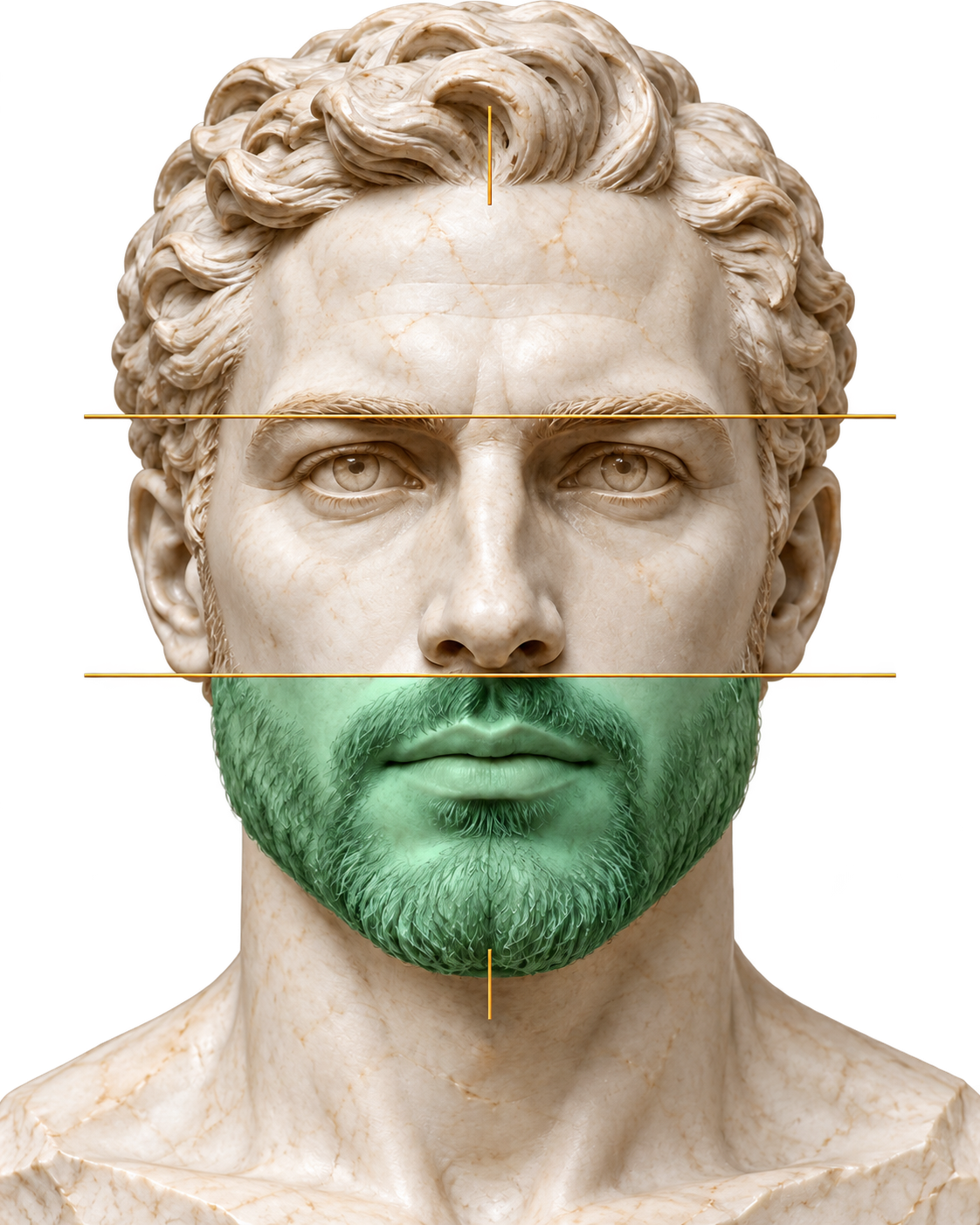
The face can be divided vertically into three-thirds facial : the upper third, which extends approximately from the hair line to the eyebrows; the middle third, eyebrows at the base of the nose; and the lower third, from the base of the nose to the chin. In a face of harmonious proportions, these three areas generally have a certain balance, although they are obviously never perfectly identical.
When lower third of the face appears relatively short or poorly developed compared to the average third and the upper third, the beard can become a real visual correction tool. By keeping longer under the chin and around the jaw, it gives the impression of a longer, wider and more structured lower face. On the other hand, a very short beard or drawn too high will not necessarily produce this effect.
The beard can be particularly interesting when the chin appears slightly back, when the jaw lacks width or definition, or when the transition between the neck and face is weak. A well-cut beard obviously does not alter the bone structure, but it allows for visually modify contours It can project the chin further, accentuate the mandible angles and create a sharper jaw line.
This effect may also be interesting in people with relatively high fat content. When more fat is stored in the cheeks, under the chin or neck, the natural contours of the jaw may become less visible. A sufficiently dense and correctly drawn beard allows artificially to recreate a sharper separation between the face and neck and to give the face a more structured appearance.
However, the beard must be adapted to each morphology: the objective is not simply to let it grow to the maximum, but to use its length, volume and lines to reinforce the proportions that one wishes to highlight. For example, a person with an already very long lower third may prefer a shorter beard, while a face with a poorly projected chin may benefit from more length at the front and under the chin.
The beard must therefore be regarded as a genuine facial morphology tool : Well chosen, it can significantly change the perception of the chin, jaw, length of the face and its overall level of definition.
If you wear a mustache, keep the hair out of your lips and check its balance with the rest of the beard. A short beard and a very long mustache can create a desired contrast, but this is not mandatory.
Keep a simple routine
Wash the beard according to your activity and skin, without multiplying the stripping products. After the shower, dry it gently. On a long beard, a comb and a small amount of care can facilitate styling. Clean the head of the lawnmower and replace the worn blades to limit pulling.
If shaving often causes incarnate buttons or hairs, space the passages, avoid straining the skin and seek advice from a dermatologist if irritation persists.
When a shorter beard is the best choice
An irregular shoot is not a failure to correct at all costs. A beard of a few days, a maintained mustache or a clean shave can accompany a face better than a forced long beard. The lens is a clean result, compatible with your push and easy to maintain.
In short: let it grow, photograph, choose a simple length, draw the contours in small steps and re-evaluate the face and profile rendering.
Guide summary
- Assess your beard growth
- Choose a consistent length
- Draw contours without mounting them too high
- Adapt beard to face proportions
- Keep a simple routine
A useful question
What length suits a patchy beard?
Start with a short, even length. The contrast with sparse areas is often subtler than with longer hair.